
Following the first Wi-Fi 8 solutions unveiled in October 2025, Broadcom today announced additional chips at CES 2026, painting a more complete picture of the upcoming standard.
These include an Accelerated Processing Unit (APU) and two dual-band chips. As it turns out, like Wi-Fi 7, Wi-Fi 8 will continue the sensible trend of not including the 6GHz frequency in certain applications.
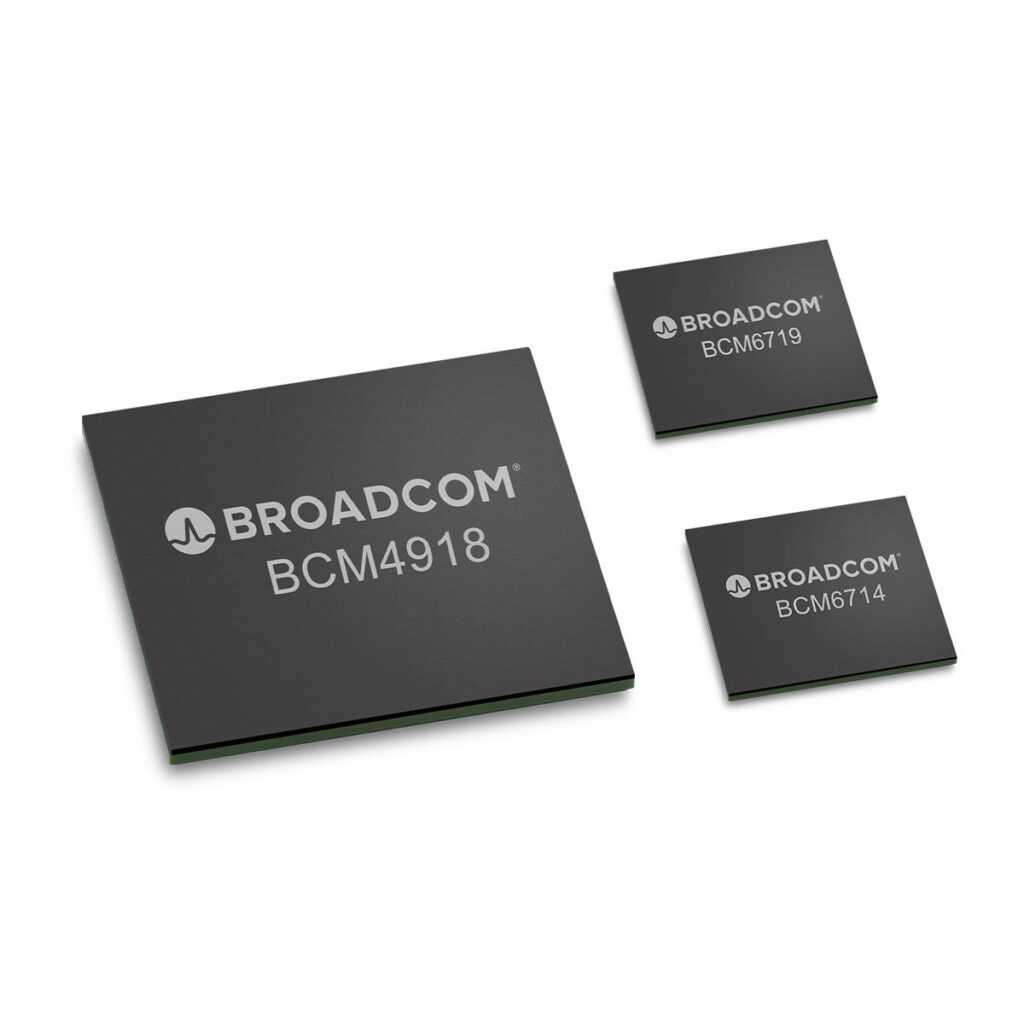
Broadcom’s Wi-Fi 8: Next-Gen APU and dual-band devices
Broadcom’s new Wi-Fi 8 hardware includes three components. Apart from the BCM4918 APU, which is a processor, there are the BCM6714 and BCM6719 chips for dual-band transceivers.
According to Broadcom, the combination of the APU and one of the chips above creates a new dual-band “unified Wi-Fi 8 platform” that allows operators to “deliver new real-time agentic applications for residential consumers with built-in security and low power.”
In other words, they will be used in future dual-band Wi-Fi 8 routers and access points.
BCM4918 Wi-Fi 8 APU: Built for AI Edge
As with the previous announcement, Broadcom also ties its new Wi-Fi 8 hardware to artificial intelligence.
Specifically, it says the BCM4918 Wi-Fi 8 APU is a “system-on-chip designed to unify high-performance computing, networking, and AI acceleration in a single, tightly integrated silicon.”
In any case, per Broadcom, the BCM4918 APU’s highlights include:
- High-performance CPU complex for general-purpose software workloads.
- Integrated Broadcom Neural Engine (BNE) for on-device AI/ML inference and acceleration.
- Advanced networking engines to offload both wired and wireless data paths, enabling complete CPU bypass of all networking traffic
- Integrated cryptographic protocol acceleration end-to-end data protection without performance compromise.
- Multi-Gigabit Ethernet interfaces for seamless integration in high-throughput applications.
Broadcom says the BCM4918 combines the flexibility of a traditional CPU, the intelligence of the Broadcom BNE, the efficiency of a network accelerator, and the protection of dedicated crypto engines to create a new class of secure, AI-ready Wi-Fi 8 platform.
BCM6714 and BCM6719: Integrated Dual-Band Wi-Fi 8 Radios
The two dual-band chips, BCM6714 and BCM6719, are similar in nature. Broadcom says they are both highly integrated Wi-Fi 8 solutions that combine 2.4GHz and 5GHz radios in a single chip.
What sets them apart is their hardware specs. The BCM6714 features 3×4 specs, with three 2.4GHz spatial streams and four 5GHz spatial streams. The BCM6719, on the other hand, sports 4×4 specs, with each frequency having four spatial streams.
Other than that, their highlights include:
- Integrated multi-chain 2.4GHz and 5GHz functionality, simplifying system design and lowering cost.
- On-chip 2.4 GHz power amplifiers (PAs) for reduced external components and improved RF efficiency.
- Hardware-assisted telemetry engine, powering the capability introduced in the BCM6718, providing real-time network insights and analytics as input to edge-AI models for QoE measurement, enhanced security, and reduced operational cost.
- Advanced eco-modes and power optimization for ultra-low energy consumption.
- Third-generation digital pre-distortion to reduce peak power by 25%.
A more complete Wi-Fi 8 picture
It’s important to note that the BCM4918 Wi-Fi 8 APU is not exclusive to the two dual-band chips above. According to Broadcom, it can also be used with the previously announced BCM6718 radio chip.
As a result, there is now enough hardware for both tri-band and dual-band Wi-Fi 8 solutions that, per the standard’s specs, feature Seamless Roaming, Congestion Avoidance, and Inter-AP Coordination, with secure Edge-AI processing to deliver much better real-time connections in all types of environments.
Availability
Broadcom says it is currently sampling the BCM4918 APU and two new dual-band Wi-Fi 8 devices, the BCM6714 and BCM6719, to its early access customers and partners. That’s also the case with the company’s prevoius Wi-Fi 8 chips.
As a result, Wi-Fi 8 routers or access points will likely be available sometime this year, even though the new standard is not expected to be ratified until 2028.


Comments are subject to approval, redaction, or removal. You're in the no-nonsense zone and that applies BOTH ways.
It's generally faster to get answers via site/page search. Your question/comment is one of many Dong Knows Tech receives daily.
Thank you!
(•) If you have subscription-related issues or represent a company/product mentioned here, please use the contact page or a PR channel.