
After the first attempt a year ago, Morse Micro made Wi-Fi Halow a reality at CES 2026 by unveiling the HaLowLink 2, the first router of the long-range standard to be available worldwide.
Now, it’s only a question of when we can find Wi-Fi Halow devices to take advantage of them. In the meantime, it’s worth noting that this router can also support 2.4GHz Wi-Fi 4 clients.
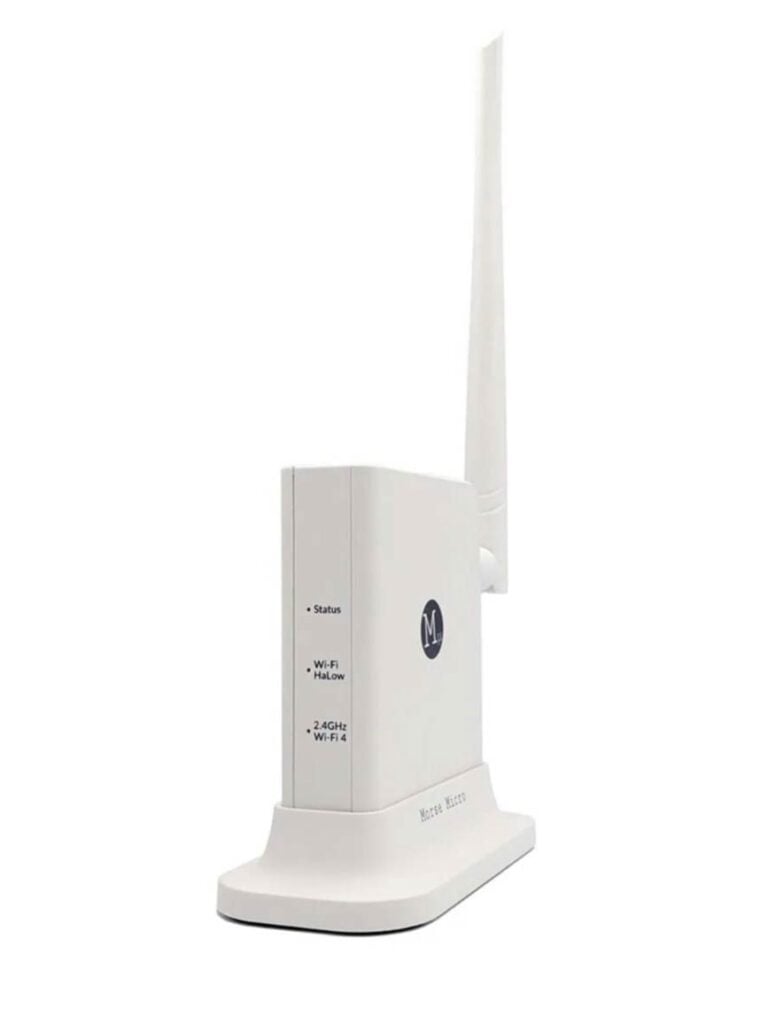
HaLowLink 2: A router designed for IoT applications
If you’re new to Wi-Fi Halow, it’s a Wi-Fi standard that shares the same characteristics as general Wi-Fi but focuses on long range and low power consumption rather than bandwidth.
Using the 900MHz frequency band, a Wi-Fi Halow connection can stretch for miles, with enough bandwidth for simple applications, such as sensors or low-resolution video surveillance.
The strength of Wi-Fi Halow versus other low-power wireless standards, such as Thread or Zigbee, is that it uses the same network protocol as standard Wi-Fi, making it much easier to manage connected devices.
The power of 2.4GHz Wi-Fi 4 and Wi-Fi Halow
According to Morse Micro, the HaLowLink 2 is a “Wi-Fi Certified, all-in-one Wi-Fi HaLow router” that can also work as an access point or extender. It’s designed to help the secure deployment of “long-range, low-power wireless networks for Internet of Things (IoT) and IoT 2.0 applications.”
Morse Micro says the new router is equipped with its latest and highest-performance MM8108 Wi-Fi HaLow chipset and is compatible with all regions where the standard is applicable, including the United States, Canada, Australia, the UK, Europe, and Japan.
When working with Wi-Fi Halow devices, the HaLowLink 2 can deliver up to 43Mbps throughput at extended range thanks to 256QAM modulation rate and 26dBm internal PA on MM8108.
Additionally, the router comes with a 2×2 2.4GHz Wi-Fi 4 access point to support traditional Wi-Fi devices with up to 300Mbps of bandwidth, ensuring it remains relevant in an environment without any Wi-Fi Halow clients.
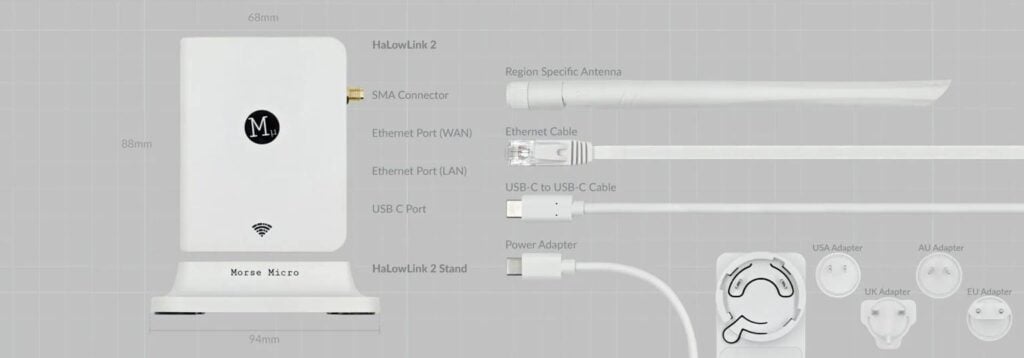
For uplink and wired devices, the HalowLink 2 comes with two Gigabit ports. The router uses a USB-C port for power and includes socket adapters for all regions.
According to Morse Micro, the HaLowLink 2 is powered by a MediaTek MT7621 CPU, 256 MB of RAM, and 32 MB of flash storage. As for firmware, it runs OpenWrt 23.05 to provide a flexible software foundation via an intuitive web-based interface, SSH/CLI access, configuration wizards, and streamlined over-the-air software updates.
In other words, you can manage the HaLowLink 2 the same way you do any other standard Wi-Fi router that has a web-based user interface.
To sum up, the new Wi-Fi Halow router’s highlights include:
- Sub-GHz Wi-Fi HaLow (Morse Micro IEEE 802.11ah MM8108)
- 2.4 GHz Wi-Fi 4 (MediaTek IEEE 802.11n MT7603E)
- Dual Gigabit Ethernet ports and USB-C power/data interface
- Mediatek CPU (MT7621)
- Long-range transmission with optimized power efficiency for IoT devices
Other than that, like the HaLowLink 1, the HaLowLink 2 is a compact device with region-specific antennas and power adapters included.
Availability and pricing
According to Morse Micro, the HaLowLink 2 is available now and costs $129 in the US. If you have a Wi-Fi Halow or Wi-Fi 4 device, it’s definitely worth a try.


I question why this standard isn’t being adopted instead of Thread. It seems like it’s better in every way, lower frequency that doesn’t interfere with 2.4 GHz Wi-Fi and Zigbee, exponentially faster, transfer speeds, like you can put this on a security camera, a Wi-Fi speaker, or even a phone and it would be usable for basic things, I mean maybe it’s not quite as low power as Thread because it’s still Wi-Fi based, but I really do hope that this standard gets adopted more. Seems like a no-brainer. By the way, Thread is IP based as well, but I believe that it requires a translation hub that is part of the Thread Border Router that, to my understanding, performs a type of NAT. Seems like Wi-Fi HaLo wouldn’t need such a translation layer if it’s literally just Wi-Fi running on a different frequency.
I agree and I don’t know why, Andrew. But likely it’s in the money. Vendors often care more about the bottom line than making life better.
In that light, investing in Wi-Fi Halow can be risky. Hope that will change.