
Morse Micro, an Australian company with a strong push to make Wi-Fi Halow a reality, today announces its latest hardware supporting the wireless standard with an ultra-long range: the MM8108-M20.
This chip is designed specifically to help hardware vendors in the US and Canada bring Wi-Fi HaLow devices to market faster.
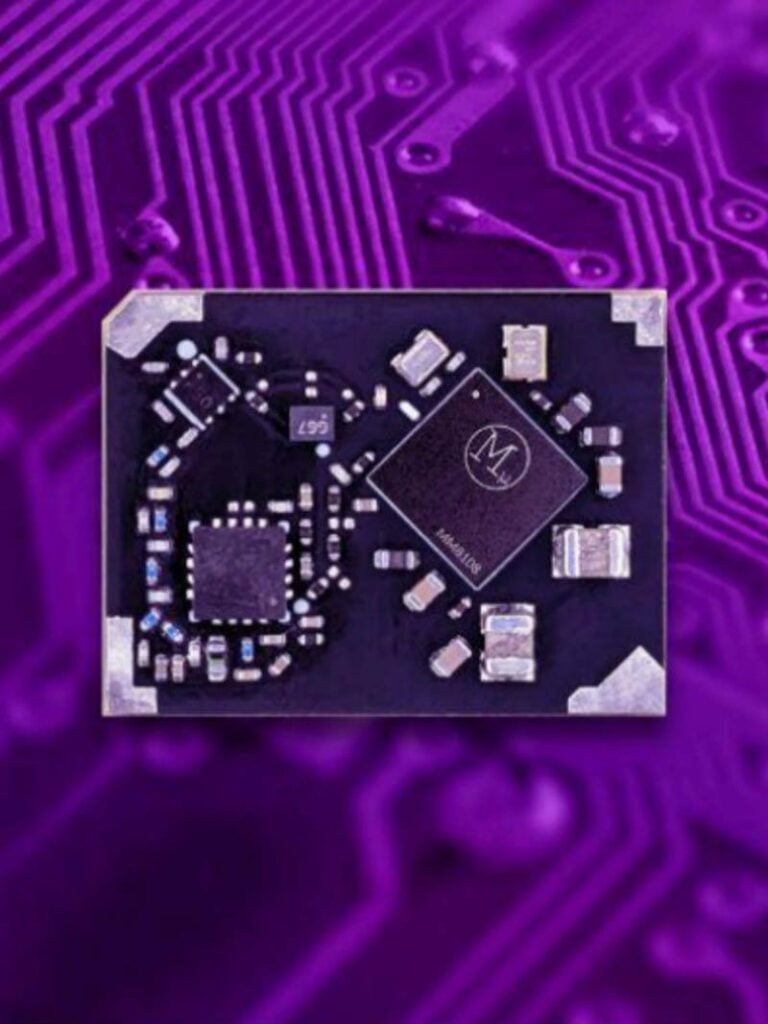
MM8108-M20: A high-powered Wi-Fi HaLow module for low-power IoT devices
The MM8108-M20 is built on Morse Micro’s second-generation MM8108 Wi-Fi HaLow System-on-Chip (SoC) for IoT end devices.
Morse Micro says it’s a fully integrated compact module measuring 18.5 mm x 14 mm, designed for the 902-928 MHz frequency range, and supports 1 MHz, 2 MHz, 4 MHz, and 8 MHz channel bandwidths. As such, it offers OEM vendors the flexibility to optimize range, throughput, and power consumption across a range of applications.
Morse Micro says that the MM8108-M20 combines its Wi-Fi HaLow silicon with an external high-power amplifier delivering up to 28.5 dBm transmit output power. Additionally, it comes with a surface acoustic wave (SAW) filter tuned for the 902-928 MHz band, which is available in the North American markets.
Most importantly, Morse Micro says that the MM8108-M20 is FCC/IC Certified and is ready for both access points and end-devices such as surveillance cameras, sensors, or any applications where long range is more important than high bandwdith.
Speaking of bandwidth, the new chip supports a single-stream PHY rate of up to 43.3 Mbps at 8 MHz bandwidth. It features flexible host interfaces, including USB 2.0 High-Speed, SDIO 2.0, and Serial Peripheral Interface (SPI). As a result, it allows for easy integration of Wi-Fi HaLow into embedded platforms and devices.
While 43.3 Mbps may seem low compared to traditional Wi-Fi, Halow is a standard designed for devices that don’t require much bandwidth, which is the case for most IoT hardware. A door lock, for example, only needs a few Mbps to complete a lock or open command. In fact, thanks to high-compression methods, many security cameras require only a few Mbps to deliver live footage.
Morse Micro says the MM8108-M20 is an important step in its strategy to make Wi-Fi HaLow easier to adopt at scale. On this front, Michael De Nil, co-founder and CEO of Morse Micro, offers this statement:
“The MM8108-M20 is more than a new module—it’s another accelerator for the Wi-Fi HaLow ecosystem. By making our second-generation silicon available in a high-power, integration-ready form factor, we’re helping module partners, OEMs, and other embedded product teams move faster, reduce development complexity, and bring long-range IoT products to market with greater confidence.”
Availability
Morse Micro says the new chip is already available for sampling to Morse Micro’s certified module partners. Hopefully, soon enough, popular IoT devices will be available with Wi-Fi Halow instead of other low-power wireless standards such as Zigbee, Z-Wave, or Thread. That’d make life much easier for consumers.


Comments are subject to approval, redaction, or removal. You're in the no-nonsense zone and that applies BOTH ways.
It's generally faster to get answers via site/page search. Your question/comment is one of many Dong Knows Tech receives daily.
Thank you!
(•) If you have subscription-related issues or represent a company/product mentioned here, please use the contact page or a PR channel.